|
|












MyCincyTutor.com
MyCincyTutor.com
Day 1
The alarm went off at 5 am and I found that there were still things to do to get ready for my trip! After 2 hours of weeding out non-essentials to lighten the load of my backpack and solitary suitcase, I had 10 minutes to spare to inhale a bowl of Cherrios. My son was prompt to pick me up and away we went to the Dayton Airport. We had great time conversing about all kinds of academic topics, such as recent books we read, world leaders, Obama, poverty and how it affects the outcomes of children. Our personalities are so much alike that we feel extremely comfortable in each other's presence.
At the check-in counter, I learned that I didn't quite accomplish enough weeding out of my luggage. With a maximum limit of 50 lbs per piece of luggage, I was 13 lbs. over the limit. Graciously the staff at United suggested I buy another suitcase, one that was really cheap at $15 in the adjacent shop. I was permitted to have 2 pieces of luggage in my travels with United. But, just the thought of handling that much luggage on the train to Cambodia ( and possibly travelling with all the chickens and livestock, maybe), I didn't think it would be a good idea. So, I proceeded to open my case, right there on the floor and remove shoes, shirts, an unnecessary umbrella and various other sundry wanted items that I thought I couldn't live without. "Yeah", I thought . "Maybe I don't need 3 swimsuits".
On the plane I met someone, maybe by chance or maybe by divine intervention, who pummeled me with questions to determine who I was, where I was going and WHY I was going to Thailand. Eyeing all of my books in my backpack, she also inquired about those. "Oh, I'm writing a book". This piqued her interest even further and the questions spilled out for the next two hours. For those of you who already know about my book, it definitely is focused on God and his means of communicating with us. We shared many spiritual experiences and I told her a few of the stories in my book. Through all of this, I found a new friend, we had lunch in Chicago in-between our flights and tried to solve all the world's issues.
The flight to Bangkok is long from Chicago and the 'Economy Section' of the plane does not afford hardly any free space. I can't recall being so cramped on other international flights. For some time, I tried to analyze the cost/benefit of such an arrangement for United. More seats mean more money. But, don't the customers get cranky from being all balled up for hours on end? Might they choose another airline? I know that Quantas, Australia's premier airline, was just absolutely a travel delight. This was torture!
I tried to get some work done on my computer by placing it on the eating tray that connects to the seat in front of me. But, no matter how I configured my set up, I was barely able to extend the lid to see the screen. Then, the gentleman in front of me decided to kick back his seat to take a nap and…..it was all over. I had my computer rammed into my gut, pinning me against the seat. The other travelers, mostly notoriously polite Japanese, observed what happened and looked at me in such a sympathetic manner. But, their body language gently suggested, "This is your problem, lady".
Since I am the consummate opportunist, I craned my neck to look for better seating arrangements. Ah, to my delight, I spotted an open seat that had plenty of leg room near the major exit door. I asked a flight attendant for permission to move. She gladly allowed it. About 2 hours into the flight, another attendant interrupted my feverish typing to announce to me, "Ma'am, are you willing to pay for the upgrade in seating?". I was bewildered as to the tone of her voice and what she was implying. " Please?" I stammered, quickly jumping my mind from the computer to judge her obviously irritated questioning. "Um, another attendant said I could sit here", I stammered and smiled (when in doubt, smile).
"This is business class and an upgrade", she explained with lips narrowing even more with discontent. With the speed of light, I evaluated the circumstances and questioned internally how these seats could be an upgrade when I have been persistently smelling urine and feces from the latrines across from my seat?
"Who allowed you to sit here? Which attendant was it?" the not-so-nice attendant demanded.
With solidarity for the attendant, who showed me such a kindness, I said firmly, " I don't know her name".
The stewardness strode off in a huff and I thought, for sure, she would find out who gave me that seat. She returned again and questioned me further.
" Are you WILLING to open the emergency door in the case of a problem? You HAVE to agree to sit there", the attendant proclaimed with self-imposed authority.
With compliance, I stated proudly, "Yes, I will open it. And, I can because I'm really strong".
This last comment did not appease her one bit!
"Well, you must read the safety card in your seat", she bellowed and strode off.
Now I truly relished my new found treasure in this seat! It was more valuable than my old one, and it looked that I was going to keep it! Shortly thereafter, a smiling young couple came up to me, faced me and the woman asked me point blank, "Are you a writer?"
"Well, somewhat. How did you know?" Because I see on your computer, it looks like you are writing a book".
"What the h….???", I thought. "Have they been looking over my shoulder and reading my compositions?"
"Are you writing about your trip to Thailand?", she quizzed again.
"Well, I do try to incorporate everything I do into my occupation", I explained hoping to satisfy her curiousity.
" Is it a book?" , she asked with rapid fire determination.
"Well, I'm actually working on two literary pieces, one is a book and the other is like a blog. I'm working on the blog, right now".
Overjoyed, the man now joined in and a lengthy conversation ensued. I learned they both were going to Thailand to study the culture of the people, as it relates to the ancient people of Thailand. Full of glee, they explained the kinds of adventures they would be experiencing, which included days and days of silence and mediation, as well as Thai kick boxing. They spoke as if all three of us were united in a literary Mecca of human exploration of cultures and minds.
"Hey, don't they realize I am just a gal from Morrow, Ohio?", I pondered.
The Bangkok airport is absolutely beautiful. The architecture is modern, but it displays many cultural norms in a very tasteful way. As I was finding my way to the baggage claim area, I passed a group of flight attendants dressed in Arabian garb complete with veils that covered their heads and swirled around their necks. They were absolute beauties, every single one of them!
Going through customs, I heard a meek, shy voice cry out, "Mom……Mom!". Recognizing the familiar voice of my daughter, I turned my head automatically and there she was, full of smiles! I breathed a sigh of relief that she looked good. My daughter, Elise, has a tendency to stop eating whenever she feels stressed. All along prior to my trip, I worried what I might behold after not seeing her for six months. I made a vow to myself that I would bring her home if her health was being compromised by this teaching gig in China.
We briskly departed the airport and found a taxi cab with a driver that faked not having knowledge of the English language. My research prior to the trip with the Lonely Planet book warned that anybody and everybody in Bangkok will try to earn as much money as they can from you. One of the examples they presented was the famous Bangkok taxi driver. The book said that they will fake getting lost finding your destination in order to earn more cab fare. They said that they will also pretend to not understand English, throwing up their hands, " No understand English!".
I sat in front with the taxi driver and gave him the map to our hotel (highly recommended by Lonely Planet!). My daughter asked the taxi driver slowly, "Do… you… know?". After living in China, she explained to me that you must speak slowly to the people in order for them to understand your message. He seemed puzzled, but nodded and pointed to the map giving indications that he knew where we wanted to go. As we buzzed along the relatively modern highway, which by the way contains huge images of the King and Queen of Thailand in full color at every pedestrian overpass, I began to converse with the driver. He grunted and spoke Thai, indicating he did not understand English. I made several attempts again and received the same response. I turned to Elise in the back seat and said to her, "Should I tell him that I will call upon the powers of heaven?". I did this as a test for the taxi driver's knowledge of English. He immediately began to laugh. I turned to him and cooed, "Ah, so you DO know English!". His smile evaporated. Then his face became rigid, he turned to examine Elise, and looked forward from then on. I believe he got us directly to our hotel.
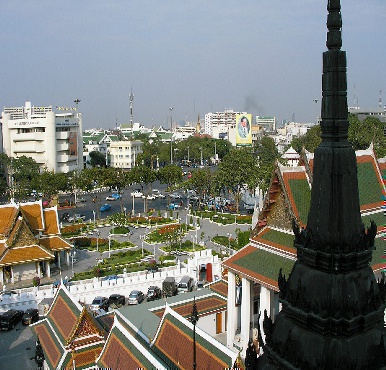
Our hotel is located in 'Old Bangkok'. I chose this area because it is within walking distance to all the temples and palaces. As a result, it lacks the modern architecture of the newer parts of the Bangkok. The closer we got to our hotel, the more seedy the environment became. I began to think that maybe I made a mistake in my choices of hotel. We arrived in the city about 1 a.m. and the place was just buzzing with people! Everybody was just hanging out and motorcycles loaded with 2,3 or sometimes 4 people were zigzagging in and out of traffic. Drawing nearer to our destination, I saw many young girls gathered together just sitting on various concrete walls and wooden benches along the narrowing roads, watching traffic as if in search of someone. I thought to myself, "Can you spell P-R-O-S-T-I-T-U-T-E ????" I worried that Elise would be very worried about the quality of my choice of hotels. Given the late hour, I began to think quickly of a plan B, should this hotel be in the category of 'flea bag'. When the driver stopped at the door, I saw that the entrance was pretty and a doorman greeted us at the curb. I decided to stay. The staff was very friendly, given the hour, and was pleasantly surprised that the room was very clean and nice.
Day 2
Elise and I slept into mid-morning to honor our pledge that this trip would have no stress. I was awaken by a local playing the flute outside in the streets. The ethnic melodies he/she played radiated off the buildings outside, giving the music a special resonance. As I lay in bed, enjoying the respite, the activities in the street below began to escalate. It sounded as if a marketplace existed below. Voices that bartered for goods began to poison the beautiful music I heard earlier.
Part of the amenities of the Boonsori Hotel is a free breakfast each morning. We entered the small front desk area and an all-smiles,officially dressed bellman showed us the pathway to the breakfast area. He led us to a narrow paved path shielded by bamboo-like trees on one side from the little avenue next to our hotel. A beautiful songbird filled the air with music. The eating area was open ,airy and lacked walls all around the perimeter. The year-round mild, and sometimes very hot weather, allowed for this type of architecture, I assumed. Large tri-fold wooden structures with Thai art gave life to the concrete floor and interior walls. I was happy to see that maybe this was a good choice of hotel after all!
A young Thai girl, very small and petite, with a cherubic face and drawn back shiny dark hair, greeted us with a placard that showed pictures of three options for breakfast. Option #1- sunny side up eggs, option #2-scrambled eggs and option #3- egg omlet. Not much of a choice, but all I hoped for was to be healthy after eating the eggs. Several parents of the students I teach, who were more worldly than myself, warned me repeatedly about the high risk of getting sick from local Thai food. Surely, I thought, that this hotel would be careful not to sicken their guests. Elise and I pointed to our selections and she quickly scurried off to deliver the request to the backroom kitchen. A small selection of fruit, juice, toast and the littlest sausages I've ever seen awaited on a buffet table.
I could see the mutual joy in my daughter's eyes that, yes, this was a good choice of hotel. But, I secretly wondered what vision awaited on the other side of the bamboo trees. I recalled the encounters with the prostitutes along the road and wondered what might be seen in the sunlight! First on our agenda for this day was to get exchange some of our U.S. dollars for Thai currency, the Baht. Our hotel concierge directed us down the adjacent street to a bank that lay several blocks down towards a heavily traveled road.
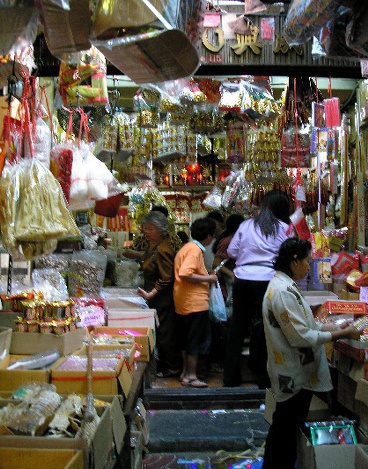
We decided to walk to the bank instead of using a local tuk-tuk (an open air buggy powered by an attached motorcycle). We strolled down the middle of the narrow street because the sidewalks on either side were loaded with merchants selling their wares. "Ah!", I thought, "These are the sources of the noises I heard as I lay in bed." All kinds of items were being hawked. About 50% of the stalls offered food for sale, anything from fruit to grilled chicken. The road appeared very dirty underfoot. Locals seemed to walk aimlessly past us with no particular destination. It was mostly men who wandered about. I saw that the women and children stayed within the covered stalls, many of whom remained even behind the stalls carrying on daily functions, such as combing their hair, creating more items to sell or simply idling away the hours watching the foot traffic.
As we passed the stalls, the women would cry out to us to buy their wares. As we continued past them, their voices would get louder to grab your attention. Not all would do this, but if you made eye contact, it was all over! For them, making eye contact was an indication that a sale was close at hand! I learned early that making eye contact, even in a friendly Cincinnati way of greeting strangers, resulted in an escalating plea halfway down the block. If you made eye contact too many times, a harmony of pleading voices ensued!
Every so often, a dog crossed our path in the street. These dogs, mostly mixed breeds, looked like they could be rabid. Their scrawny bodies, covered with dusty fur, walked about with no owner in sight. Some of them had sores on their bodies, others were maimed. We also had to dodge the plentiful motorcycles that zig-zagged around the people, stalls and other debris in the street. An occasional tuk-tuk or taxi driver sped past us, busily on their way to capture their next client. It was a bustling sea of activity on such a small, narrow street.
I saw that on either side of the street, beyond the stalls, were crumbling buildings with tin roofs. I thought, "Is this where the market people live?" I peered down small alleyways that radiated from the narrow road we travelled and saw conditions in the alleys that were more meager than the road we travelled. Water would run randomly from the buildings and collect in the street. I was careful to step over these little streams, wary that they might contain sewage. I did not sense that the air smelled bad. Yet, I can't rely on my sense of smell. Years of working in chemistry labs kind of inculcated my ability to smell as other people do. My daughter, who has been living in China for 6 months, repeatedly said, "The air smells so fresh!". Air in China must be horrendous, I judged. Surely, the scenes I've witnessed thus far could not produce clean smelling air!
After exchanging our U.S. dollars, we grabbed a taxi to get to one of the many train stations in Bangkok. This particular train station offered passage to Cambodia; we were advised by Lonely Planet to get our tickets early to avoid delays the day of our departure five days from now. We arrived at the train terminal about 1pm in the afternoon and it was bustling with mostly Thai travelers. The central area was huge and similar to the train terminal in Cincinnati that now houses a museum. Benches and other seating filled the central area and all people faced the ticket windows and digital displays showing arrival and departure times of trains. Most of the travelers seemed to be of the general population. No one transported luggage, but carried sacks of their belongings. I saw some older people comfortably squatting and eating food as they waited. Their old, wrinkled bodies appeared to be superbly flexible to maintain those poses while eating. The crowd even contained monks, cleanly adorned in their bright orange sheets with shaved heads.
Following our ticket purchases, Elise requested that we just 'wander' in Bangkok. We followed the heavily travelled roads by foot, heading in the relative direction of our hotel. We saw on the map that there was a temple nearby and decided to go in that direction. I was constantly amazed how I viewed so many near misses by the motorcycles laden with people. Women, who sported skirts, would sit sideways on the motorcyles without clutching anything for support. Children would be sandwiched in-between their parents, weaving in and out of traffic without regard to traffic lights. It seemed all vehicles were speeding. Everyone was in a hurry to get to their destination! Several times, Elise and I had to walk in the streets because the sidewalks had many obstructions. Horns blared when we didn't move out of the way in a timely manner.
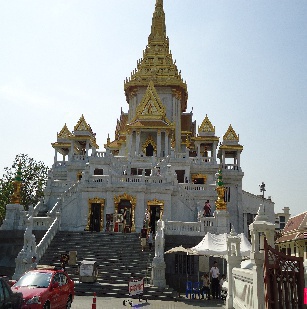
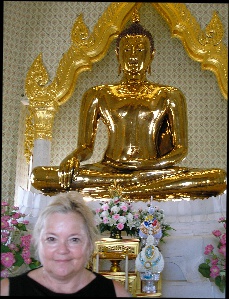
The air was heavy and humid by this time of day. I was sweating profusely! We finally found the temple and it was smack in the middle of Chinatown. This area of town was known for its markets and the stalls lined every possible space on the sidewalks. I was happy that the temple area was surrounded by ample concrete patios that were devoid of the crowded conditions on the street. This was the Temple of the Big Golden Budda, renowned for not only its immense height, but it was also covered in the purest gold. We learned that the interior was made of clay and mud, densely packed together to form the Budda.
Before entering the temple, a visitor must remove one's shoes and be modestly dressed. Shorts, Capri pants, spaghetti tops and bare shoulders were not allowed. However, anyone of any religious affiliation was welcome to visit the Golden Budda. The Thai new year brought many local and national people to the temple to give offerings of lotus flowers, burning incense sticks and necklaces laced with real flowers, much like you see in the Hawaiian leas. Every temple has a set of concrete stairs to ascend into the sanctuary. As we entered the temple, it had an atmosphere of reverence. People spoke in hushed tones, while others knelt with their feet neatly tucked under their bodies, bowing in prostration to the Big Golden Budda.
I learned that the Budda, whose likeness is seen EVERWHERE as statues throughout predominantly Buddist Thailand,was a real person. In my ignorance, I always believed that he was a mythical figure, much like the Greek Gods. The story goes that he made a diligent effort to reject the world and attained a state called Nirvana. Golden Budda statues were found everywhere in the Bangkok marketplaces , in all shapes, sizes and positions. My lack of knowledge regarding Budda made me make a mental note to do more research on this topic when I returned home.This HUGE Budda has a lengthy history and has been transported throughout Southeast Asia. It is in Bangkok that he has come to rest, for now.
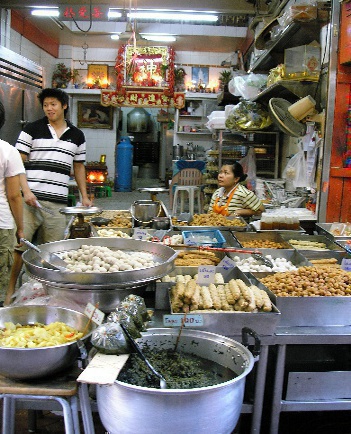
We continued our wandering about Bangkok and wound up in the central marketplace in Chinatown. Every sidewalk and alleyway was blanketed with vendors, who mostly sold food items. The smell was absolutely atrocious. Given that my sense of smell has been deadened somewhat, I thought that my ability to sense these smells as being very strong meant that this place just really STUNK! Every imaginable fish and sea creature was offered. Who knows how long they have been offered for sale, possibly days, weeks months? The smells were almost unbearable. And, my acute hunger really complicated my revulsion for what I smelled and saw.
As we passed the stalls, merchants held out samples of their wares for us to eat. I politely rejected each time, wary of the possibility of getting food poison. I thought that the Thai people must have a stomach like dogs do. You know, dogs will even eat road kill. I know that my own dogs did! Much of the food presented for sale looked like road kill. Some of the fish were dried and so flat from dehydration that I could have use them to replace the soles of my shoes.
Every stall had a shrine to Budda in the very back that, I assumed, allowed the families to worship as they worked. Glowing with lit candles, the shrines were very ornate and contrasted starkly with the crude and simple structures of the stalls. This marketplace was a happening place and not a tourist trap. Locals shopped for all of their grocery needs there, it seemed. People were examining the wares and haggling at every stall. The aisles were narrow and at times only allowed for single file passage. Despite the narrow paths, motorcycles rode up and down the market and everyone had to get out of the way somehow!
Without buying anything, we exited the marketplace and searched for a place to eat that was not street food. After walking for at least an hour, we found no acceptable place to eat where we felt that the food would be safe. Giving up, we grabbed a taxi to our hotel and asked the concierge for recommendations. They suggested a restaurant by the river, which promised to offer a scenic view. We grabbed another taxi, which by the way is pretty cheap. A twenty minute ride is about $2.00 U.S.
We arrived at the entrance to the restaurant and multiple oil torches greeted us at the entrance. It looked very Caribbean looking and sported many fish tanks containing live lobsters, exotic fish and maybe other sea creatures that could be on the menu. It was a lovely place and had seated dining and waiters. We crossed a threshold and the building opened up into an open air restaurant with a magnificent view of the river and modern bridge. The evening lights from the buildings across the river dotted the landscape and boats of many kinds travelled up and down.
We ordered 3 items jointly from an extensive menu that numbered the choices. The numbers went up to well over 100, offering soups, salads, stir fry and many other types of foods. It took a long while to decide what to order. It was a relaxing evening and our bill, including taxes, tips and drinks, amounted to about $20 U.S. Considering that we ordered all seafood items, I felt our bill was really reasonable given the caliber of the restaurant. It was a good ending to an eventful day in Bangkok.!
Day 3
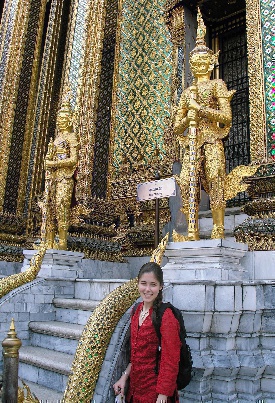
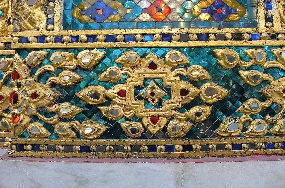
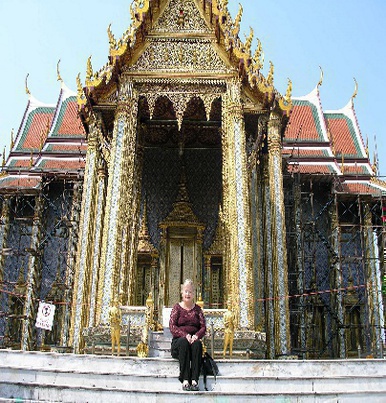
We decided to start our day visiting the Grand Palace. This palace was an effort by one of the King Rama's (currently King Rama IV rules) to move the capital of the country from across the river to a new location, which is now 'Old Bangkok'. The palace is surrounded by a walled structure of smooth white sandstone with moderately style carvings. However, as you enter the palace area, all of that moderation is transformed into a mystical land of palaces and temples literally covered in diamond shaped cut glass. Every building shimmers in gold accented with brilliant mosaic designs in cut glass. I have never seen anything like it! The specter totally outshines (no pun intended) anything that Kings Island, the Cincinnati Zoo or Riverfest could do! I could only imagine what European explorers from the West beheld what they saw upon being led to the leader of the land.
Thai National Guardsmen guard many of the more sacred structures. At the center of the complex, and I mean complex because there must be at least 30 huge buildings all serving the King Rama and his cortege, is a huge temple that houses the Emerald Budda. Every Budda we met ( : ) has some sort of history. It is customary that they were transported throughout Southeast Asia to be honored at different, well populated locations. So, some of these Buddas have been housed in various temples in Cambodia, Thailand, Laos, India etc. In order to enter the temples, you must always climb about 15 steps. I noticed that all the temples had about the same number of steps. This specific number of steps must be a significant number to them. There are always spacious patios before the temple entrance that are loaded with abandoned shoes by people entering the temple in their bare feet.
At every temple, Buddist worshipers present flower offerings of either solitary, stemmed lotus flowers, a lei of stringed very bright yellow flowers that is about 16 inches in circumference or a small lei of odd shaped white flowers, about 6 inches in circumference, with 3 roses that are stringed separately and dangle from the lei. Every temple had just these three types of flower offerings, no other. There is also an opportunity to offer incense sticks to the Budda that are lit, a prayer is offered and then, extinguished in an ornate sand containing basin.
The Emerald Budda is not really made of emeralds, but is actually made of a vibrant green jade stone. It was discovered by conquerors during one of the wars, covered with white plaster. One of the conquerors noticed that the nose of the Budda was chipped and saw a green substance underneath. After removing the plaster, a very green Budda appeared!
Every Budda in a temple is surrounded with massive amounts of real gold decorations. There are other gold statues that surround the Budda, plus many gold lace structures, intricately cut, so that they provide a background of shimmering light reflections that dazzle the eye. The pictures do not do the scene justice! Ironically, there is so much opulence in the temples throughout Thailand, but the people who support them are generally poor. The people put all their money in the temples, I believe.
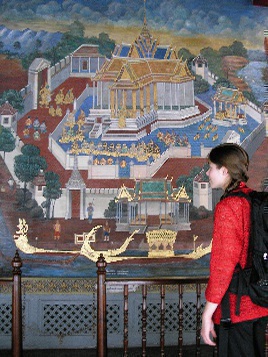
The Grand Palace had housing quarters for the King's elephants, crematories for humans, as well as elephants, halls, residences for the King's court, etc. Every building was a masterpiece, even the crematory for elephants! I noticed that there weren't many areas supporting gardens. All areas were well paved with stone or concrete. One of my favorite buildings was one that contained continuous murals that were painted on every side of the square building that told a 100 year old story of King Rama III in pictorial form. The explanation for each scene was explained in Thai at the bottom on a plaque, but one could easily determine what had happened at that time period within the 100 year epic. The 'bad guys', or invading forces were represented as monsters with animal looking faces, while the Thai people looked human. I don't know how many murals there were, but a good guess would be at least 300 or more that covered the building and shielded by the surrounding portico, or covered walkway area.
We had lunch at a, I believe heavily favored by the prominent local population,Thai restaurant. When we entered the eatery, it seemed all heads turned to view the foreigners. We were the only people of European descent there. It took a very long time for a waiter to come. I warned Elise that they may not serve us because, just possibly, we may not be welcomed! I thought it may be some sort of exclusive restaurant for Thai's only. Being so afraid to get sick from street food, I spotted the restaurant and decided that they probably would not have their chicken meat hanging from a string for a week or more, without refrigeration, before they served it to their customers! They eventually came around to us. The service was not like in the U.S., where promptness counts. No, they acted like it was a favor to serve us.
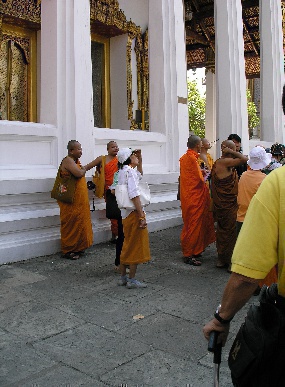
A Buddist monastery was right next door, so we decided to stop in and take a look. This was a very good decision because there were very few non-monk people wandering the complex. It was an actual working monastery. Buddist monks, robed in shocking orange sheets wrapped discretely about their naked bodies, roamed the complex and in deep meditation. I learned later that monks are not permitted to touch a woman and, conversely, woman are not allowed to touch them! I noticed that each time we passed a monk, he would avert his eyes from us. I also learned that Budda is revered for resisting temptations from the earthly world, which very much includes women. The monks' goal is to imitate Budda, which means women are off-limits. However, I did see some 'techie smart' Buddist monks at the Grand Palace and they let me take their picture. They were very young and enjoyed the attention we gave them. After the shot, I gave them a 'thumbs up' and they smiled broadly. The monks at this monastery were older.
I learned that this monastery contained relics of the real-life Budda. Relics can be bones, hair or fragments of garments worn by the Budda. We tried to ask what type of relics the monastery housed, but no one seemed to understand our English. So, it will be an unknown for now. Elise and I climbed a very long winding wooden staircase in the center of the monastery. At the top of the staircase, we reached the parapet of the steeple that contained the relics! A small cushioned bench was in front of a locked, metal grill box. We knew inside there must be something special because it contained a large golden hat surrounded by the usual gold surroundings. The box was maybe 3 ft. by 3ft by 4 ft. and not very large because it fit inside the steeple. At the time, we had no idea what we were viewing. A monk had just left the little bench and quickly passed us with his head down and lips moving in prayer. I thought it may be something special and later learned the box contained the relics of Budda.
As we descended the staircase, all of a sudden we heard monks chanting. We couldn't believe our good fortune to be present during this occasion! We followed the sounds of chanting in order to discover their source. We imagined it might be like the Catholic monasteries at home, where the monks would all gather together, prayer books in hand, and singing in devout, harmonious voice. After walking through the maze of walkways that contained a gold Budda at every intersection bordering the exterior walls of the monastery, we leaned out an arched window and discovered a speaker that broadcast the chants to the city of Bangkok! It was a recording!!!! Evidently, this happens everyday about 5 pm at every Buddist temple worldwide.
Day 4
We awoke at 3:45 a.m. to catch our 5:55 a.m. train for Cambodia. As the taxi wound its way through the streets of early morning Bangkok, I saw that the prostitutes were still working their corners. The sight of this made me very sad. These girls were very young, some beautiful others not so beautiful. I recalled that when I coached a tennis team in Amsterdam, the other female coaches wanted to visit the famous Red Light district of Amsterdam. I begged off at first, but decided that this may add to my knowledge base and not be so bad. The sight was truly traumatic for me and I pledged to pray a rosary for every prostitute I saw. I read about a year or so ago that the Red Light district was being dismantled! The Dutch government decided that this is not the business they wanted to promote. I would like to think that my prayers had something to do with that.
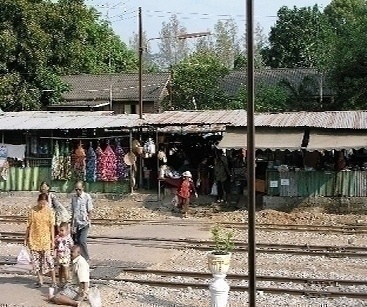
Bangkok city, at 5 a.m. was beginning to wake up. Vendors on the street were preparing for another full day of calling out to passersby. As we neared the train station , saw that the city is arranged just the opposite of U.S. cities. We are familiar with urban sprawl, whereby the poor remain behind while the more affluent radiate out to the outskirts of the city. It is just the opposite here. The poor live in shanty towns that surround the city. I viewed so many of the inside of these shanties, because many of them have large openings. Dirty rags cover the open windows for privacy. The poor were busy at work gathering their wares or making new wares or dishes to be sold that day. The sight was ugly to behold.
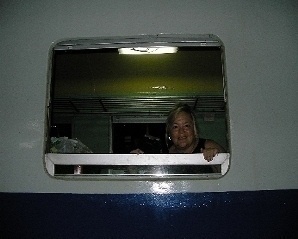
The train system is one of those straight out from the 1950's and is very much a part of the transportation system in Thailand. We boarded the train with all the other Thai locals. When buying our tickets, a couple of German girls touring the Southeast for 7 weeks joined us in the car. I could tell that they felt more safe being with us, and vice versa. There is more security in numbers when you are female traveler. They asked to share a taxi with us once we reached the Cambodian border. We gladly agreed! There was also a group of boys travelling together who spoke Spanish. Otherwise, the car was loaded with Thais.
The train slowly left the terminal and proceeded out of the city slowly. I got a fuller experience of the shanty towns and observed all that they did to prepare for the day. Dim interior lights showed the silhouettes of the Thai poor preparing for the day. Some were cooking, some were just stretching their bodies and I saw shirtless men pounding with anvils creating some unknown wares that created bright sparks that lit the night. Have you ever wondered where all your Goodwill clothing donations go, if not bought by our U.S. poor? They go to these third world countries, sold by the pound by Goodwill. Goodwill told me this after I inquired about what happens to items not sold in the Goodwill stores. The poor in Thailand are clean, but wear mismatched clothing. It seems they are concerned more with functionality than style. If you want to take a trip back to the 70's or 80's fashion styles, go to Thailand. It's on the backs of the poor. Your donations!
I was glad to leave the city and enter the countryside of Thailand. Rice paddies abound and I got to see close up how they are farmed. They are definitely soggy and some contain about ½ of water. White birds, called egrets, stand with their tall stick-like legs searching for small fish or crustaceans.These birds are beautiful to behold with their long graceful necks and thin long beaks. They slowly ply the marshes in search of food. I've also seen them on the backs of water buffalo, that roam the paddies freely on higher grounds. The egrets pick off buys from the water buffalo and then, in turn, the buffalo are not 'bugged' by insects. It is a true symbiotic relationship!
Clutches of shanties can be found as we travelled through the countryside. The set-ups were the same as in the city; it is a shameful sight. This time I noticed that each one had an area set aside for worship to Budda. This area possessed some sort of structure on a pole that looked like a dollhouse, Thai style. Each group of shanties had what looked like a watering hole about the size of a baby portable swimming pool and sometimes twice that size. They weren't very large. The holes contained the murkiest water I have seen. Do you remember how you used to make 'mud soup' as a child? Well, this is what the water looks like. On top of that, there was usually somebody in it! I found out later from a taxi driver that these holes were used for fishing. If they wanted a fish for dinner, they went out and got it!
About 3 hours out of Bangkok, the terrain became very dry. It looked as if a lighted match would set the fields ablaze! In fact, I saw a lot of torched areas. I think they used the 'slash and burn' method of clearing land. The train stopped to pick up and drop off the locals about every 20-30 minutes at these remote outposts. The train was packed with travelers, but no animals allowed! At every stop, a local peasant would hop on the train with prepared foods that didn't look like anything I have ever seen! YUK! Well, maybe the basket of eggs looked familiar. At some stops, little kids from the shanty towns would hop the train without paying for a ticket. Just like in the old days! Devilish smiles on mischievous children seem to be a universal phenomenon.
When we arrived at the border, we had to be processed through three different places in order to cross the border. We had to dodge carts pulled by peasants containing all kinds of materials. The odors from the carts were horrendous, the streets were really dirty and the air smelled of human waste. In fact, we were instructed by Lonely Planet to cross the 'stinky creek' and you will find the place to get your Visa to cross the border. It was REALLY stinky! I imagine that they do not have waste treatment facilities like the U.S. does. As we waited for very long periods of time, I was able to watch traffic. The carts were all about the same, a two wheeled box with very long handles for pulling. The peasants still wear the round Asian hats like in the movies. The only difference between what you see in the movies regarding Asian peasants is that many of them wear those surgical masks. It is really interesting to see how and when they pull those masks out.
We hired a taxi to take us to our hotel in Cambodia. The drive was 2 hours long and it only cost $48 for the trip. It was a great opportunity to see the Cambodian countryside. They, too, had ornate Buddist Temples at the center of villages. Cambodia's population is about 90% Buddist and the remainder are Christian or Muslim. The countryside was lush and full of large rice paddies. The road we traveled had only been paved 2 years ago. Our driver said that Cambodia is progressing rapidly and trying to catch up to the modern world. The road, a main thoroughfare, was highly traveled by everyone all carrying large loads of people and produce.
Our driver explained that land mines left by the war during the U.S. invasion of Cambodia blow up some peasant every day. He warned us not to hike in unknown areas because we may hit one of those mines. We also saw many elementary schools and they were very clean and beautiful buildings. The schools often were found surrounded by the shanties they served. The children are required to wear uniforms that are similar to U.S. schools, white shirts and navy blue skirts or pants.
As we entered Sien Reap proper, we noticed a brand new university that just opened. He explained that the country is promoting higher education now that Pol Pot and the Khmer regime has died and the people now have a near democracy.
Day 5
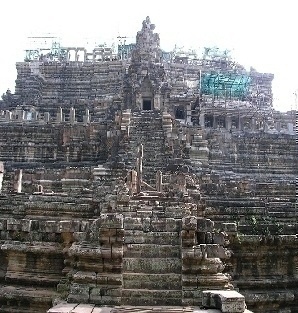
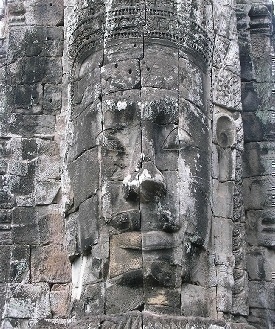
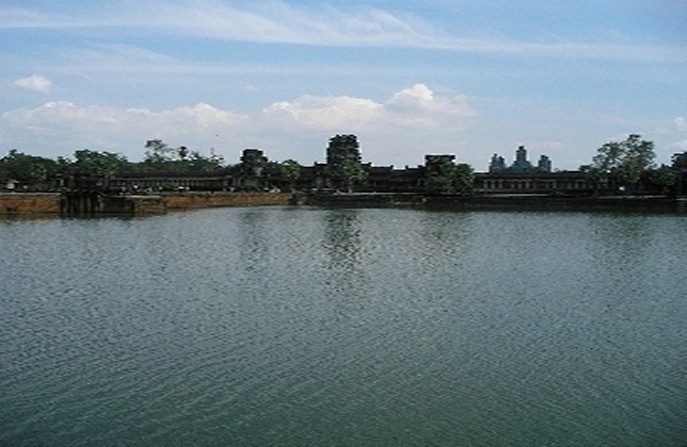
It is or first day to visit Ankor Wat, the sight of 12th century ruins of a Cambodian leader who was famous for how much construction he did during his reign. This sight is listed as a world wonder and contains the largest religious development in the world. I can't recall how many square Kilometers the area possessed, but I know that it cannot be traveled on foot in a short period of time. The sight contains the King's palace and is surrounded by Hindu temples all made of sandstone. Over the last 900 years, a black mold has really taken over the stone. Also, the ruins are really falling apart! Every year, scores of hand carved blocks of stone fall off the structures and have to be retrieved.
After viewing the shimmering Grand Palace in Bangkok, I must say that these ruins appear to be an eyesore. I learned that the largest complex was built in 37 years with 385,000 slaves. I inquired of our English speaking Cambodian guide where they got the slaves. He explained that back then, the people existed in tribes. Tribes would war upon tribes and capture the men, women and children to employ them as slaves. Thus, the slaves were of Cambodian descent. I recalled the same story from the locals in Fiji, when I visited there about 6 or 7 years ago. The only difference is that the victorious Fijians would often eat some of their captives; cannibalism was a part of their culture. I also have learned in my research of the heritage of African Americans in the United States that African tribes warred upon other African tribes, captures the inhabitants of the conquered village and, either keep some of the captives for slaves, or sell them to the Europeans who visited the ports from time to time. I guess people are the same no matter where you go, for better or for worse!
But, back to the Cambodian take on slavery…… The Cambodian king declared himself a 'God-king' and made his own people, as well as the slaves, worship him as a god. Given that the slaves didn't want to tick off the god, they worked very hard for him in building Angkor Wat. The sandstone had to be obtained from a small mountain that was a distance of 5 kilometers away. It was grueling work transporting the stone. They often used waterfalls and waterways to transport the stones, which all of them were about 2 ft x 2 ft x 3 ft in dimensions. The thresholds contained very long stones on top. Nearly every stone was ornately carved with figures and designs.
Well, the god-king was a very hard driving master of the people. Eventually, the slaves got fed up, revolted and overthrew him. I really don't know if they killed him, which is usually what happens to deposed monarchs. I learned in a recent book I read, The Great Upheaval, that any monarch throughout the periods of 1700's to the 1800's was overthrown if the common people's needs were not satisfied. The only one to survive and die a natural death was Catherine the Great of Russia. The people loved her because she really wanted the people to be educated. She was the first monarch in the history of mankind to require women to be educated. She also built hospitals for the people and improved the infrastructure of the country she ruled. So, they let her live to a ripe old age and mourned her death. After the god-king of Cambodia was overthrown (or killed), the building stopped!
There is no real security to protect these antiquities at these revered sights of Angkor Wat. Tourists roam the ruins freely, climbing the very narrow and steep steps while clinging to fissures in the stone walls for support. Oftentimes,you can't climb a set of steps by just standing upright. The are so vertical and the foot rest is so narrow that you have to literally 'climb the stairs' on all four. Stones are everywhere and there is no one to stop you from taking some home as souvenirs. All the tourists are respectful of the place. I didn't see one person disturb any sight or attempt to steal something for the trip home.
The ruins are also a danger to traverse. There no danger signs warning you of loose stones and absolutely no railings guarding drop offs. You explore these ruins at your own risk. Besides, who are you going to sue if you get hurt? The Cambodians? Hah, that's funny.
Day 6
Elise and I did another day of touring of the temples in the huge Buddist/Hindu complex at Siem Riep. Today we are visiting the temples that are on the outskirts of the main temple, Ankor Wat, and the King's Palace. I learned today from the many guides that are available for hire that the many temples were built by the Cambodian Kings there in honor of their mothers, fathers, wives, etc. Yet, each temple had a purpose, too. They were functional in nature. There were two temples today that I enjoyed the most. The first one was used principally for 'purification'. The design was really neat. The temple was in the middle of a large square, possibly 150 ft. by 150 ft. This pool would collect the rain and, when it got too high, the water ran off into four smaller pools that were also square and at a lower elevation. Sandstone block steps that surrounded each pool descended. It was a beautiful sight to behold! The guide said that thousands of people would come to the temple to purify themselves from their sins.
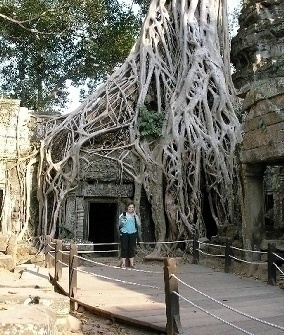
The second temple was the one where Tomb Raiders, starring Angelina Jolie, was filmed. It is famous for the 400 year old trees that have taken over the temple. In one scene, Jolie picks a lotus flower from one of the trees and falls into the temple. Europeans discovered these abandoned temples many years ago. I'm not sure when, but the guides said that all of these temples were swallowed up by the jungle. Can you imagine the surprise the Europeans had to find these things in the middle of nowhere? Also, the sight of these temples housed and were used by over 100,000 Cambodians. The temple with the pools required 8,000 Cambodians to maintain alone.
I really haven't touched upon the weather and local folk yet, so I think I will do so now. Since Cambodia is near the equator, the temperature is pretty much consistent because it doesn't experience a greater degree of tilt during the change of seasons like we do in the U.S. . The closer to the equator a country lies, the less variability of weather temperature. That is why Florida has more warm weather year round and no snow! The temperature here is hot right now, maybe 90 degrees. I understand that in the summer, the temperatures are well over 100 degrees everyday! It is very humid because of the abundant vegetation that holds in the moisture in the air. I wear my hair up in a clip everyday just to stay cool!
The people in the town of Siem Reap are considered more well-off than the peasants in the countryside. I suppose the tourist dollars help with that. There are many exquisite hotels here for such a poor country! Tourists began arriving in Siem Reap to visit the ruins in the early 20th century, thus slowly building a booming tourist trade. There are lots of foreigners here, mostly from Great Britain, France, Australia and Germany. We've met 3 people from the U.S. so far here. When the locals find out we are Americans, they take great delight in knowing us. I had one of the hotel hostesses ask me about the Chinese new year and I told her I really didn't know. She said, "Oh, you are European?" and I responded in the most thickest, Hicksville accent I could muster, " No, I'm Aaaaaammmmerrriiiicaaan". The song, ' I'm proud to be an American……..' could have been appropriately played at that moment. Hey, do I LOOK Chinese???? Just wondering……a blonde Chinese….now that is interesting.
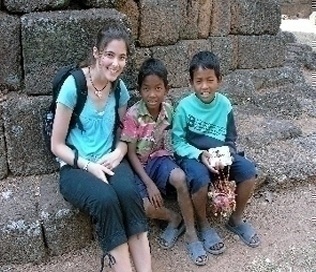
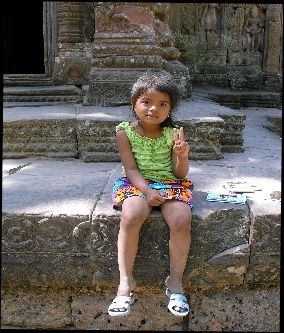
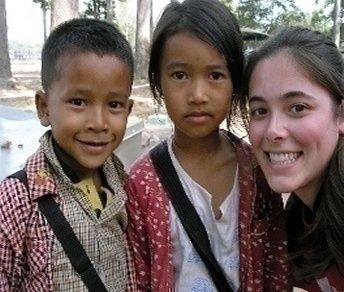
Every Cambodian is trying to sell something, including the small children. When you get out of your tuk-tuk, they swarm about you selling everything from water to little trinkets that look like they actually came from China. And they don't leave you alone!!!!! This is the only thing that I don't like about my experience in Thailand and Cambodia. It forces you to be rude, and I don't like doing that. My daughter explains that this happens in China, as well. She walks past them without any eye contact or communication. I explain to them why I can't ( or don't want to) buy what they have to sell. The children here have learned to be 'players' early. They put on a show of sadness and utmost poverty when you don't buy anything, while their pockets bulge with candy and U.S. $1 bills.
The town of Siem Reap is a 'happening place' at night. All the tourists congregate in the streets and PARTY. Last night, Elise and I experienced a night in Siem Reap on Pop Street. It reminded me of the book (and movie) Eat, Love,Pray. We really had clean fun!
Treking Through Thailand and Cambodia